
See his channel HERE
Category Archives: Dyscalculia Overview
What if the problem is not the student?
What concerns me is that we place the burden of adaptation on the student. Rather than questioning whether an outdated education model remains fit for purpose, we ask young people to bend themselves around it. Those who can, are labelled successful. Those who can’t, are often left questioning their abilities. The impact is lifelong.
Read more HERE
What kind of teaching do dyscalculic learners need?
CRA Instructional Sequence: , Abstract instructional sequence is an approach that moves students from using concrete manipulatives to representational drawings to abstract numbers when learning new concepts and is a best practice for all learners. Dyscalculic learners will need to experience this sequence multiple times and gradually, when developing new skills and understandings.
Read more HERE
Dyscalculia in Adults: Recognizing and Managing Number Blindness
You’ve always struggled with numbers — not just complex math, but basic arithmetic, telling time on analog clocks, handling money, or keeping track of quantities. You’ve been told you’re “just not a math person,” or perhaps you’ve chalked it up to laziness or poor concentration. But for many adults, the underlying cause is dyscalculia: a neurodevelopmental learning disability that specifically affects the ability to process numerical information.
Dyscalculia is often called the “forgotten learning disability” — far less recognized than dyslexia, yet affecting approximately 3–7% of the population. In adults, it frequently goes undiagnosed, leaving people managing its impacts without ever having a name for what they experience.
Read more HERE
Can people with dyscalculia read sheet music?
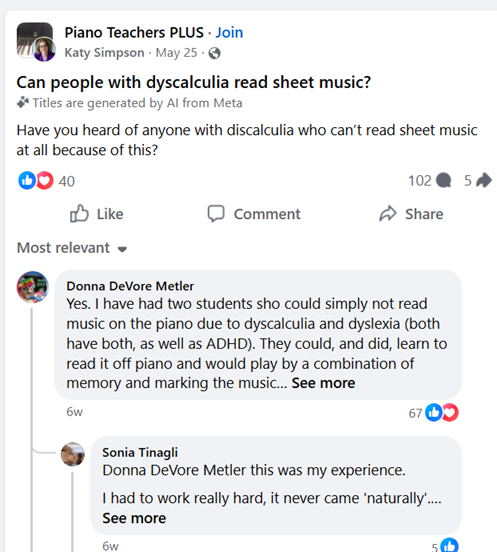
Read more about it HERE