
twice-exceptional

Dyscalculia: News from the web:

The concept of gifted students who also have learning disabilities (G/LD students), also referred to as “twice-exceptional” students, has become widely accepted, however only a very small number (~5%) of articles on this subject use empirical data. Much is written about this population based on very little empirical evidence and there is not yet much consensus on how to define and identify these students. The research in the link for today also summarizes a literature overview and draws conclusions.

Read all about it: HERE

Visit us at DyscalculiaHeadlines.com
A service from Math and DyscalculiaServices.com
Trouble with Math? Dyscalculia Testing Online
Become a Dyscalculia Tutor. DyscalculiaTutor.org
Missing out

Dyscalculia: News from the web:

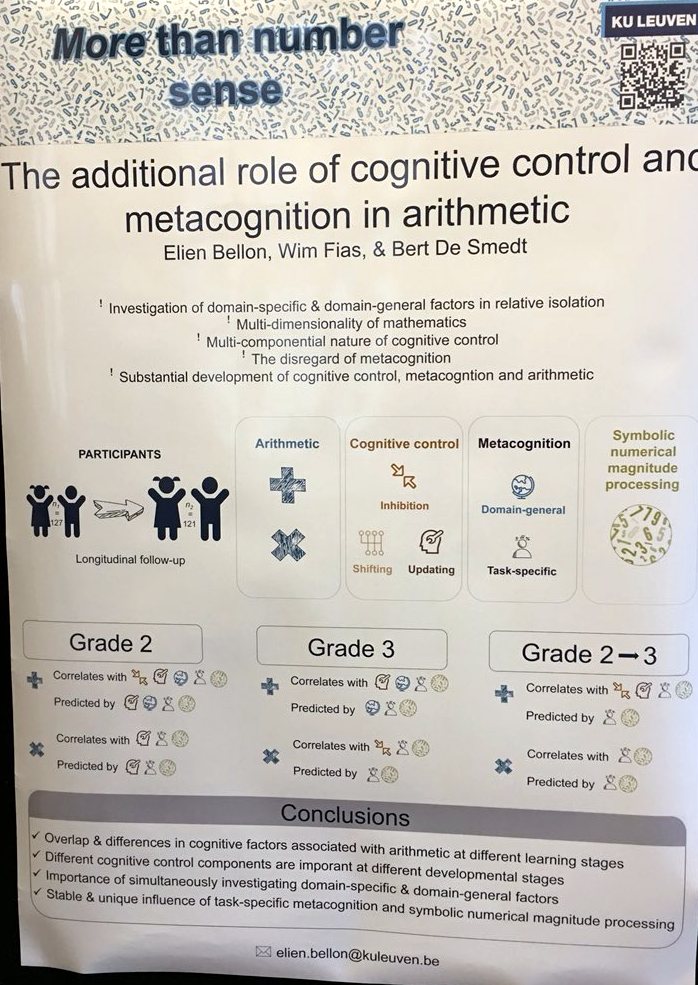
We are not at the conference from the Mathematical Cognition and Learning Society, but we are sure missing out. So we follow the twitter feed for some news and updates and saw this wonderful poster presentation floating by.

Visit us at DyscalculiaHeadlines.com
A service from Math and DyscalculiaServices.com
Trouble with Math? Dyscalculia Testing Online
Become a Dyscalculia Tutor. DyscalculiaTutor.org

Yes you can retrain the brain

Dyscalculia: News from the web:

Many aspects of the brain can be altered as the brain is neuroplastic. “This means that the brain can change throughout an individual’s life and with the right stimuli, it can be trained to become more efficient in spite of any brain disorders or labels that one may have been born with.”


Read all about it: HERE

Visit us at DyscalculiaHeadlines.com
A service from Math and DyscalculiaServices.com
Trouble with Math? Dyscalculia Testing Online
Become a Dyscalculia Tutor. DyscalculiaTutor.org

Guidance on teaching Math

Dyscalculia: News from the web:

The Education Endowment Foundation has published guidelines for primary and secondary teachers on how to boost math skills with children. They make the following observations:

  • Pupils should master basic mental arithmetic – addition, subtraction, multiplications and division – and be able to recall their times tables quickly. Those who don’t may well have difficulty with more challenging maths later in school.

  • Pupils sometimes think “multiplication makes bigger, division makes smaller”. This is accurate with numbers greater than 1, but isn’t right when applied to numbers less than 1. So, 5 x 5 =25 but 0.5 x 0.5 = 0.25.

  • Learning how to add fractions together can often cause difficulty. For example, many think the answer to 1/8 + ½ is 2/10. Teachers can help pupils to understand that the right answer is 5/8 using diagrams which help to visualise the different values of fractions.

Read all about it: HERE

Visit us at DyscalculiaHeadlines.com
A service from Math and DyscalculiaServices.com
Trouble with Math? Dyscalculia Testing Online
Become a Dyscalculia Tutor. DyscalculiaTutor.org