A new Equal sign

Dyscalculia: News from the web:

With all due respect to Robert Recorde who invented the equal sign about 500 years ago, I’m going to suggest to changing it a bit to clarify some things.

As you may know in his book  The Whetstone of Witte, Robert Recode got tired of having to write that both sides of an equation were equal so he wrote:

” Instead of using a phrase to convey meaning, he would convey the same meaning with a symbol. What symbol could be more appropriate than a pair of equal-length lines? Nothing, noe 2 thyngs, can be moare equalle.”

In our history of working with children who have dyscalculia for over a decade, we have seen a lot of confusion about the = sign. Children believe it to mean “action” as they see the answers popping up on their calculators when they hit the button marked =. In Robert Recorde’s time there were no calculators to add to the confusion, so the problem never may have occurred to him.

Today we want to present a new design for the equal sign. Something that will make it easier to explain that both sides are in balance, are of equal value, have the same weight.
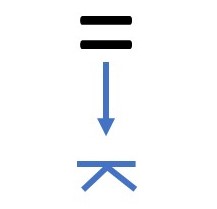
As you can see we have tried to use an icon of a seesaw, to replace the equal sign. This will remind the children immediately that both sides need to be balanced. The choice of the seesaw is just a little departure from the equal sign but we believe the impact will be large.

Please let us know what you think.

Brain Training with movement and more

Dyscalculia: News from the web:

The high school science teacher turns his students into ‘electrons’ and gets them to walk along a prescribed route in the classroom, reinforcing concepts associated with circuit diagrams and electricity. The primary school mathematics teacher gets her students to make funny shapes with their bodies that represent the numbers 0 – 9, creating a fun way to tackle mental arithmetic problems. The ICT teacher creates a variety of ‘human graphs’, getting students to line up in columns based on their chosen answers to assigned questions.

What do all of these examples have in common?: The students are using movement to solve problems and, in doing so, are engaging multiple regions of the brain.

Read all about it: HERE

Research about numerosity

Dyscalculia: News from the web:

We know that people who can easily work with both actual quantities like objects or dots and with written arabic numerals and can also easily translate between them so between the non symbolic and symbolic information, have good math skills. Reason to look into the question how the brain codes numbers like 2, 4, 6, 8 if brain sources are used for both symbolic and nonsymbolic information or that they is located in separate spots. Researchers from Western University in Canada and VanderBilt, Nashville did an fMRI study with 139 healthy adults. They used a 7 Tesla machine, which is very powerful so a great signal noise quality. They found that for specific numbers, like 4 and 6, the same neural resource was used to code for quantities of dots and written arabic numerals and also that both the left and right parietal lobes were active, also the dorsolateral prefrontal cortex and that the process is specific to individual numbers in multiple formats. Not everything can be unraveled yet and how this relates to math performance and that there are individual differences in working with symbolic and non-symbolic numbers depending on their math skills    

Read all about it: HERE